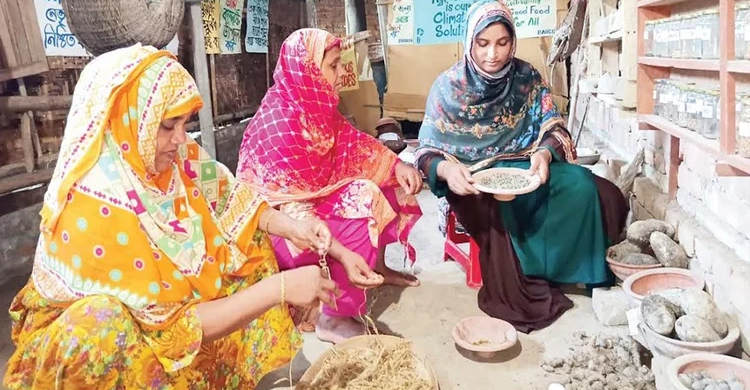
| (BSS) - A small courtyard in Bil Nepalpara village under Paba upazila has turned into a repository of nearly 200 varieties of indigenous crop seeds, thanks to the initiative of farmer Mosammat Sultana Khatun.
Sultana has been collecting and preserving local seed varieties for years. Her initiative has now reached 13 villages of Darshanpara Union, where farmers collect seeds according to their needs and exchange them with seeds preserved by other farmers.
Her journey in agriculture began after her marriage in 2012. After completing her degree in 2014, she became increasingly involved in farming and started cultivating safe vegetables in her homestead in 2016.
"I learned farming by observing my father-in-law and mother-in-law. Later, I encouraged women in neighbouring households to cultivate safe vegetables," Sultana said.
Her farming activities gradually attracted other women in the area. She began sharing her experiences with them and, in 2018, started collecting indigenous seeds from different parts of the country.
Over the years, her collection has grown into a community seed bank containing around 200 varieties of indigenous seeds. Farmers from 13 villages now come to the seed bank to collect seeds and exchange their own preserved varieties.
Sultana said she has distributed seeds to around 8,500 people so far this year, helping spread indigenous crop varieties from her homestead to farms across the villages.
Alongside seed preservation, she is promoting safe and organic farming among local farmers. She produces organic fertiliser using different locally available materials and encourages farmers to reduce their dependence on chemical fertilisers.
Eight families have already joined her initiative to produce and use organic fertiliser.
Sultana also prepares around 15 types of organic pesticides to control crop pests. These are made from local ingredients, including neem leaves, mahogany fruits and stale dhutura fruits. She also teaches women farmers how to prepare and use the natural pesticides.
With support from Bangladesh Resource Center for Indigenous Knowledge ( BARCIK), her home has now been developed into an "Agroecology Learning Center". Farmers from different villages visit the centre to collect and exchange seeds and share their experiences of safe and sustainable farming.
"In agriculture, we are becoming increasingly dependent on chemical fertilisers and pesticides. As an alternative, I use organic fertilisers and pesticides and share my experiences with women farmers," Sultana said.
Local resident Mariam Begum said they come to Sultana`s seed bank whenever they need seeds of different crops. "We get different varieties of seeds here and do not use chemical pesticides on our crops," she said.
|