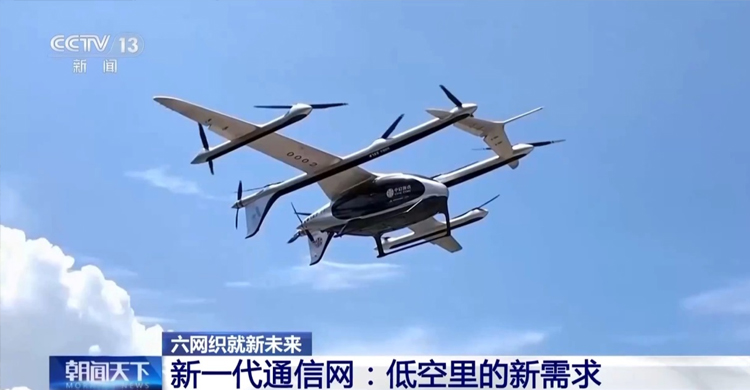
| International: In a busy commercial district of Shenzhen, several drones were recently seen testing new flight routes. The city currently operates around 60 such logistics routes, and this number is expected to increase tenfold over the next two years. As a result, demand and pressure on the underlying communication network are also expected to rise significantly.
Li Mingyang, an official responsible for Meituan’s drone flight testing, said that signal quality is affected in areas with a high concentration of glass-walled buildings. During testing, several “signal blind spots” were identified.
Relevant officials noted that operating drones in the low-altitude airspace of densely populated commercial areas is highly complex.
Yan Yan, head of Meituan’s drone public affairs department, said that during holidays and peak hours, communication bandwidth becomes insufficient, and the network often comes under heavy strain.
These challenges have increased expectations for greater bandwidth, lower latency, and the ability to operate a higher density of drones simultaneously. This year, more than 70 percent of Shenzhen’s airspace below 120 meters has been opened, allowing various types of aerial vehicles to operate in the same airspace.
Li Shipeng, Director of the Low-Altitude Economy Division at the Digital Economy Research Institute of the Guangdong–Hong Kong–Macao Greater Bay Area, said that such a large volume of flight operations requires an integrated service system. A key foundation of this system is the communication network, which must be capable of providing real-time location and operational data of flying vehicles.
Experts say that low-altitude airspace is increasingly resembling a road-based transportation system: the more flights there are, the greater the need for coordination and control. In the first four months of this year alone, logistics drones in Shenzhen completed 383,000 flights, up 38.5 percent year-on-year.
At the same time, ground control centres must constantly track drone locations, flight paths, and potential risks in real time. This requires a faster, more reliable, and more comprehensive communication infrastructure. Experts believe that next-generation communication networks with multi-dimensional capabilities will form the core foundation to meet these demands.
Wu Di, a network expert at China Mobile Guangdong Shenzhen Branch, said that traditional base stations were originally designed mainly for ground coverage. To meet the needs of low-altitude airspace, newly built 5G-A integrated sensing base stations have expanded coverage from ground to air. A single base station can now support around 100 aerial vehicles.
Shenzhen has already built 220 such multifunctional base stations, while more than 10,000 existing 5G base stations have been upgraded to support higher bandwidth capabilities.
Qin Liang, founder of Chihang Drone, said that in the future, aerial vehicles will fly farther and higher, navigating complex environments such as mountains and seas. Therefore, an integrated communication system covering air, land, space, and sea is the ultimate goal.
Experts believe that with the integration of advanced technologies such as artificial intelligence, it will be possible to safely and efficiently manage more than 100,000 flying devices in urban airspace.
Li Shipeng added that once the new-generation low-altitude communication network is fully established, enterprises will be able to connect and operate more easily within the system, making flight operations safer, more orderly, and more efficient.
Source: Xinhua–Faisal–Tuhina, China Media Group.
|