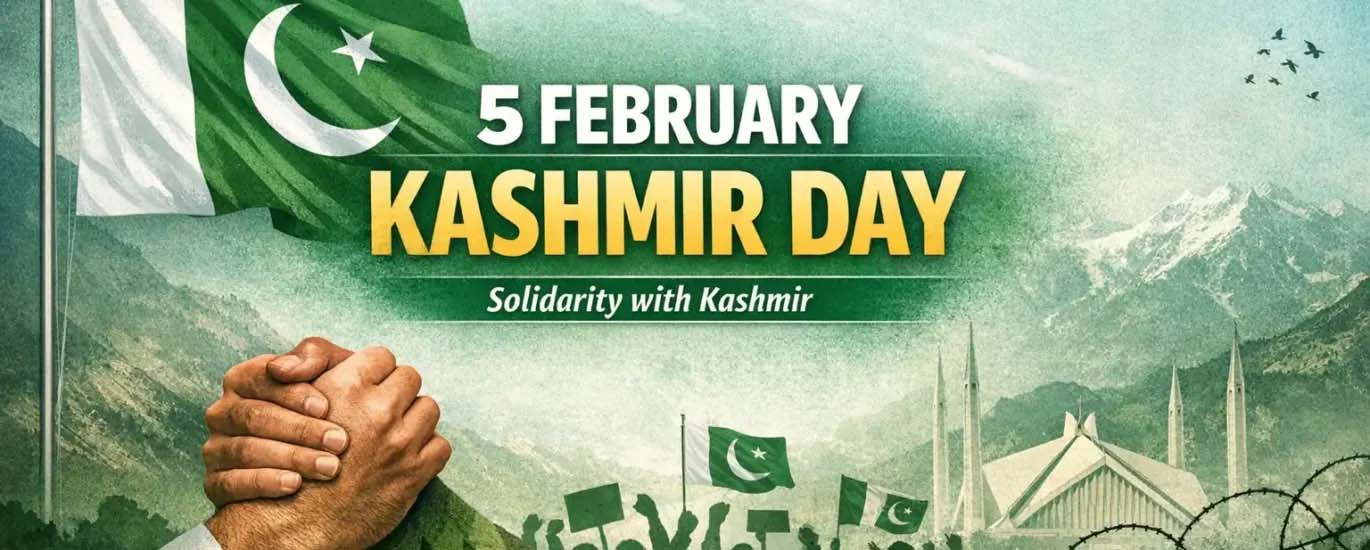
| By Amna Samar: Kashmir Solidarity Day is observed every year on 5th February across Pakistan to reaffirm unwavering support for the people of Jammu and Kashmir in their struggle for justice, dignity, and self-determination. It is a day of national unity, reflection, and renewed commitment to the Kashmiri cause. Rallies, seminars, walks, prayers, and conferences are held nationwide, while Pakistanis abroad also organise events to raise global awareness. The purpose is not only to express moral solidarity but also to remind the international community that the Jammu and Kashmir dispute remains unresolved and continues to affect peace and stability in South Asia.
Pakistan’s narrative on Kashmir is firmly rooted in international law and United Nations Security Council resolutions that recognise the right of the Kashmiri people to decide their political future through a free and impartial process. Pakistan views Kashmir as a humanitarian and human rights issue involving the right to self-determination of millions of people living under prolonged conflict and uncertainty. On Kashmir Solidarity Day, Pakistan’s leadership reiterates its diplomatic, political, and moral support for Kashmiris and urges the world to move beyond statements toward practical steps for justice and peace.
The human rights situation in Indian Illegally Occupied Jammu and Kashmir (IIOJK) remains deeply concerning. International human rights organisations and United Nations bodies have documented excessive use of force, extrajudicial killings, enforced disappearances, arbitrary detentions, restrictions on media and internet access, and limits on peaceful assembly. Since the revocation of Jammu and Kashmir’s special status in August 2019, Kashmiris have faced increased militarisation, prolonged curfews, and administrative changes that have raised serious concerns about political representation, demographic balance, and cultural identity. These conditions have disrupted daily life, education, healthcare, livelihoods, and mental well-being, particularly affecting women, children, and the elderly.
Pakistan’s foreign policy on Kashmir emphasises peaceful resolution through dialogue, respect for international law, and implementation of relevant UN resolutions. Islamabad consistently raises the issue at international forums such as the United Nations, the Organisation of Islamic Cooperation, and other multilateral platforms, urging the global community to recognise the urgency of addressing this decades-old dispute. Pakistan believes lasting peace in South Asia is not possible without a just settlement of Kashmir, as unresolved tensions continue to threaten regional stability and economic development.
International organisations and the global community can play a constructive role in resolving the Kashmir issue. The United Nations Human Rights Council, the Office of the High Commissioner for Human Rights, and other relevant bodies can strengthen independent monitoring mechanisms and seek access to assess ground realities. International NGOs, media institutions, and academic forums can document abuses, amplify Kashmiri voices, and ensure sustained global attention on the humanitarian consequences of the conflict. Transparent reporting and fact-finding missions can help build pressure for accountability and reform.
Diplomatic engagement remains another critical avenue. Influential states, regional blocs, and multilateral institutions can encourage meaningful dialogue between Pakistan and India, promote confidence-building measures, and urge respect for international humanitarian and human rights law. Political, economic, and diplomatic leverage can be used to persuade India to lift restrictions, restore civil liberties, release political detainees, and allow humanitarian access. Constructive diplomacy can also create space for inclusive discussions that involve Kashmiri representatives, whose aspirations must remain central to any durable solution.
Civil society worldwide can further contribute through advocacy, awareness campaigns, academic research, legal action, and peaceful solidarity movements. Universities, think tanks, journalists, and human rights defenders can highlight both the historical context and present-day realities of Kashmir, helping global audiences understand that the issue is not merely geopolitical but deeply human. The Kashmiri diaspora, in particular, can engage policymakers, organise peaceful demonstrations, and ensure that Kashmir remains visible on international agendas.
Kashmir Solidarity Day ultimately serves as a reminder that the dispute is about the fundamental rights, dignity, and future of the Kashmiri people. A just and lasting peace requires respect for human rights, sincere dialogue, and fulfilment of international commitments regarding self-determination. Pakistan maintains that only a peaceful, negotiated settlement reflecting the will of the Kashmiri people can bring lasting stability to the region and relief to millions who have suffered for decades. The day calls upon the international community to move from concern to action, from rhetoric to results, and from silence to solidarity, ensuring that justice, peace, and human dignity prevail in Kashmir and across South Asia.
|