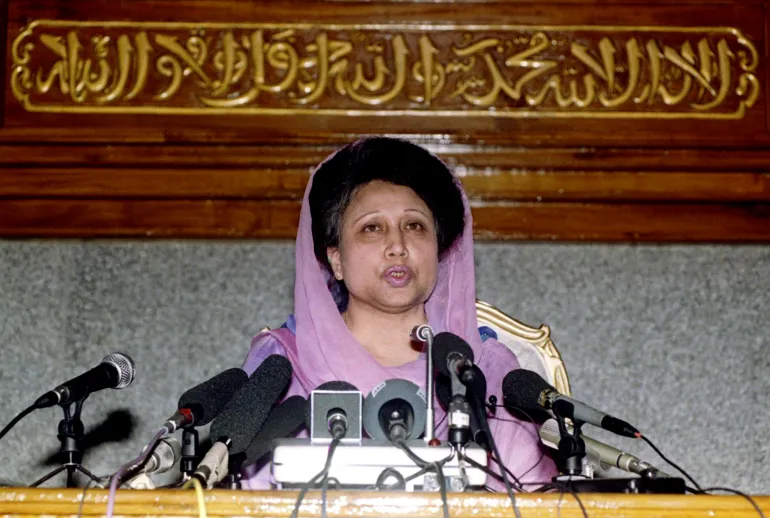
| Zahidur Rahman: Begum Khaleda Zia remains one of the most consequential and enduring figures in the political chronicle of Bangladesh. A three-time Prime Minister and long-serving Chairperson of the Bangladesh Nationalist Party (BNP), her ascent from domestic obscurity to national leadership represents an extraordinary metamorphosis—one forged by tragedy, tempered by resilience, and defined by unyielding commitment to democratic ideals.
Born on 15 August 1945 in Jalpaiguri, West Bengal, Khaleda Zia married Ziaur Rahman in 1960 while he was a cadet officer in the Pakistan Army. For much of her early life, she remained distant from the public sphere. During the nine arduous months of the 1971 Liberation War, she endured house arrest alongside her two children—an experience that underscored her personal fortitude but did not yet foreshadow a political destiny.
The watershed moment in her life arrived with the assassination of President Ziaur Rahman on 30 May 1981 in Chattogram, an act widely attributed to both domestic and foreign machinations. At the time, Khaleda Zia was an apolitical homemaker residing in Dhaka Cantonment. His death not only plunged the nation into grief but also left the BNP mired in an existential leadership vacuum.
In this milieu of uncertainty, Khaleda Zia entered politics on 2 January 1982 as a primary member of the BNP. What initially appeared to be a reluctant assumption of responsibility soon evolved into a compelling display of political acumen. Her prudence, moral clarity, and organizational competence rapidly earned her legitimacy within the party hierarchy. By March 1983, she was appointed Senior Vice Chairperson of the BNP.
In a seminal statement issued on 8 January 1982, she articulated her political philosophy with notable lucidity. She affirmed that President Ziaur Rahman had founded the BNP to consolidate the nation under Bangladeshi nationalism and to construct a polity free from exploitation, corruption, and dependency. Alarmed by the prospect of factionalism, she accepted leadership not out of ambition, but from a perceived moral obligation to safeguard party unity and national interest.
Her ascendancy accelerated when Justice Abdus Sattar fell ill, prompting her appointment as Acting Chairperson on 12 January 1984. Shortly thereafter, on 10 May 1984, she was elected Chairperson unopposed. Subsequent re-elections in 1993, 2009, and 2016 reaffirmed her unassailable stature within the party, rendering her leadership both enduring and institutionalized.
Khaleda Zia’s political identity crystallized through her uncompromising opposition to military autocracy. As the principal civilian antagonist of H.M. Ershad, she rejected conciliatory politics and instead embraced sustained mass mobilization. From 1987 onward, her unequivocal one-point demand—“Ershad Must Go”—galvanized a nationwide movement. This protracted struggle culminated in the restoration of parliamentary democracy through the 1991 general election, in which the BNP emerged victorious.
In 1991, with the support of Jamaat-e-Islami, Khaleda Zia became Prime Minister for the first time. She returned to office in 1996, and again in 2001, leading a coalition government. Her electoral résumé remains singular in Bangladesh’s political annals: she contested 23 parliamentary seats across five national elections and won every one, a testament to her formidable political capital.
Beyond national borders, Khaleda Zia played a consequential role in regional diplomacy, serving twice as Chairperson of SAARC, thereby enhancing Bangladesh’s geopolitical visibility in South Asia.
Yet her career has been persistently punctuated by persecution. During the military-backed Caretaker Government of 2007, she was arrested on 3 September and subjected to prolonged incarceration. Efforts to exile her abroad were rebuffed with characteristic defiance—she refused to abandon her homeland under duress.
In November 2010, she was forcibly evicted from her Dhaka Cantonment residence, where she had lived for 28 years. The house, allocated to her after Ziaur Rahman’s assassination, became another symbol of what she described as politically motivated retribution.
During the subsequent decade and a half, 37 cases were filed against her under the Awami League government. Convictions in the Zia Orphanage Trust and Zia Charitable Trust cases further constrained her liberty, though her sentence was later suspended by executive order on 6 August, and she was acquitted in one of the cases on 27 November.
Arrested repeatedly—during the anti-Ershad movement, the One-Eleven period, and in later years—Khaleda Zia endured sustained political pressure, deteriorating health, and denial of advanced medical treatment abroad. Still, exile remained anathema to her. Following the collapse of the Awami League government, she was finally released on 6 August by order of President Mohammad Shahabuddin.
Conclusion
Begum Khaleda Zia’s life narrative is emblematic of stoicism, sacrifice, and political tenacity. Thrust into leadership by personal tragedy, she transcended circumstance to become a lodestar of resistance against authoritarianism. Her steadfast refusal to compromise on democratic principles, even at immense personal cost, has etched her legacy into the collective memory of the nation. Irrespective of partisan divides, her imprint on Bangladesh’s democratic evolution remains indelible—and her journey, profoundly instructive.
|