|
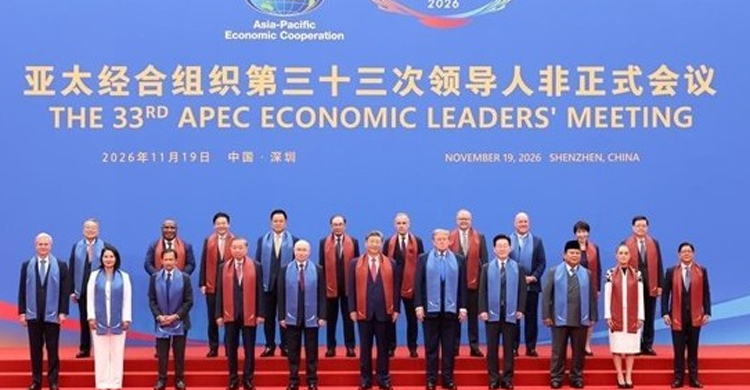
At the 2026 APEC Business Summit held in Shenzhen, Chinese President Xi Jinping proposed a major initiative: establishing the World Bay Area Economic Cooperation Alliance. Through this new cooperative endeavor, the far-reaching significance of common prosperity in the Asia-Pacific region—one of APEC`s core themes—can be realized in practice. It can be said that this concept of inter-bay-area cooperation has created an effective pathway to achieve the goal of shared development across the Asia-Pacific.
In his keynote speech at the APEC Business Summit, Xi Jinping noted, "The Asia-Pacific region is home to the world’s most important bay areas. The economies of these regions possess distinct characteristics such as openness, coordination, and influence."
These bay areas serve as some of the most dynamic hubs of the Asia-Pacific economy. Shenzhen, the host city of this year’s APEC summit, is also part of the Guangdong-Hong Kong-Macao Greater Bay Area.
Along the Pacific rim lie several major economic centers, including the Tokyo Bay Area, the San Francisco Bay Area, and the Sydney Bay Area. These regions bring together advanced scientific and technological innovation, coordinated industrial clusters, and vibrant commercial networks, making them key drivers of economic growth in the Asia-Pacific. However, for a long time, most major bay areas have pursued their own development paths. Various obstacles still remain in sharing experiences, coordinating industrial sectors, and ensuring the free flow of factors of production, preventing the immense potential of mutual cooperation from being fully tapped.
The initiative for the World Bay Area Economic Cooperation Alliance has been launched specifically to overcome these practical hurdles. Its aim is to remove barriers to cooperation across different economies and connect the vibrant bay areas along the Pacific coast. As Xi Jinping emphasized, it is necessary to "promote regional economic integration and facilitate the free flow of factors of production."
Once implemented, this alliance can become a testing ground for coordinating and integrating various factors of production. It will encourage mutual learning, exchanges of technology, capital, and talent, and resource sharing among different bay areas. As a result, the growth potential of one area will spill over into neighboring areas, accelerating the pace of coordinated development across the wider region.
Through this new initiative of the World Bay Area Economic Cooperation Alliance, the deeper significance of this year’s core APEC theme—"building an Asia-Pacific community with a shared future and achieving common prosperity"—has become clearer. Common prosperity in the Asia-Pacific is not an abstract concept confined to documents; rather, it is a multidimensional, effective, and practical blueprint for development.
The fundamental foundation of common prosperity in the Asia-Pacific lies in a commitment to open cooperation and a firm stance against insularity and division. Openness is the lifeblood of the Asia-Pacific economy—a point Xi Jinping has repeatedly stressed. As a key initiative to put the vision of common prosperity into practice in the region, the World Bay Area Economic Cooperation Alliance advocates upholding the principles of openness and partnership.
Participation from bay areas across various economies is welcomed in this initiative, alongside expectations of uncovering new opportunities for shared development by strengthening connectivity.
Innovation is the primary driver of common prosperity in the Asia-Pacific, while narrowing development gaps across regions is one of its key levers. The goal of the World Bay Area Economic Cooperation Alliance is to turn the innovative capacity and advantages of bay areas into a shared asset for the entire Asia-Pacific region. To achieve this, emphasis must be placed on building regular networks for innovation exchange, sharing research and development outcomes, and bridging digital and technological divides. Through these efforts, the development goal of "leaving no economy behind in the march of technology" can be realized.
Another crucial condition for achieving common prosperity in the Asia-Pacific is harnessing the pragmatic sense of responsibility of the business community. Xi Jinping stated clearly, "The business community in the Asia-Pacific region is at the forefront of the global economy."
One of the objectives of the World Bay Area Economic Cooperation Alliance is to create an effective platform for regular cooperation and coordination among enterprises in the region.
Under this framework, businesses in the Asia-Pacific are expected to deepen supply chain cooperation, increase investment in green projects, and encourage experience-sharing and mutual learning among small and medium-sized enterprises. At the same time, opportunities will be created to translate the consensus reached at the APEC summit into concrete projects, thereby further strengthening the market foundation for common prosperity in the region.
The vision of common prosperity in the Asia-Pacific is built on inclusive partnership and the principle of prioritizing improvements in people`s living standards. As Xi Jinping stressed, "We must adhere to a people-centered development philosophy and strengthen economic and technological cooperation with developing economies."
In the vision of an Asia-Pacific community with a shared future, common prosperity does not simply mean increasing the wealth of a few areas or groups. Rather, its core objective is to ensure that the fruits of development reach large numbers of people across the region.
As cooperation among bay areas expands, alongside industrial growth and trade expansion, economic benefits will also spread from major cities and metropolitan centers to surrounding, relatively less-developed areas.
A bay area may be small in size, yet it is connected to the vast Pacific Ocean—and this new cooperative initiative carries the broader dream of development for the Asia-Pacific region.
The World Bay Area Economic Cooperation Alliance has set sail together with vibrant bay areas. Following the principles of openness, innovation, pragmatism, and inclusiveness, the initiative is expected to move forward, forging a practical path toward building an Asia-Pacific community with a shared future and achieving common prosperity.
Source: Ruby-Foysal-Labanya, China Media Group (CMG)
|