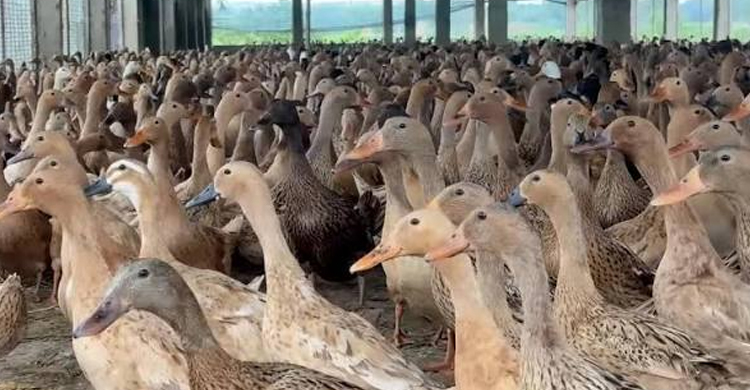
| (BSS) - Shaheen, an entrepreneur from Gayer Para village in Naogaon Sadar upazila, has achieved remarkable success by rearing ducks in open wetlands, earning a net profit of around Tk 5,000 per day after meeting all expenses.
His success has brought financial stability to his family.
Shaheen, son of Leju Mondal of Gayer Para village, was unemployed and financially destitute just a few months ago. He struggled to meet his family`s expenses. Inspired by success stories about duck farming on television and YouTube, he started the venture, which began to yield results four months later.
Shaheen told BSS that he bought 700 six-month-old ducks four months ago at Tk 300 each, investing a total of Tk 2.10 lakh. He began rearing them in an open wetland called Beel Monshur near his house.
The ducks roam freely in the wetland throughout the day, feeding on snails, fish, insects and other natural food. At night, they are given paddy and commercial duck feed at the farm.
Rakib, son of Amzad Hossain of Joypurhat district, looks after the ducks and maintains the farm.
Rakib told BSS that although the ducks forage for food in the wetland during the day, they are fed one and a half maunds of paddy and 10 kilogrammes of duck feed every night.
The daily cost of feed amounts to Tk 1,750, including Tk 1,000 for one and a half maunds of paddy and Tk 750 for 10 kilogrammes of feed. Rakib receives Tk 500 a day as wages, bringing the total daily operating cost of the farm to Tk 2,250.
Rakib said the ducks now lay at least 500 eggs a day. The eggs are sold wholesale at Tk 15 each, generating daily sales of Tk 7,500.
After deducting the daily expenses of Tk 2,250, the farm earns a net profit of Tk 5,250 a day, or Tk 1,57,500 a month.
Mohidul Rahman, general secretary of the Naogaon Nature and Life Corner, along with Nantu and Zahid of Gayer Para village, told BSS that the area is predominantly characterised by wetlands. Families in the area traditionally rear ducks on a small scale, but no one had previously undertaken commercial duck farming on such a large scale.
They said Shaheen had benefited from establishing the duck farm, which has generated considerable interest in the locality.
District Livestock Officer Dr Md Jahurul Islam told BSS that open wetlands provide abundant natural food for ducks. As ducks require substantial amounts of food, rearing them in open wetlands reduces feeding costs and makes the venture profitable.
He also said duck meat and eggs are highly nutritious. Although less commonly consumed than chicken, duck meat and eggs have considerable demand.
|