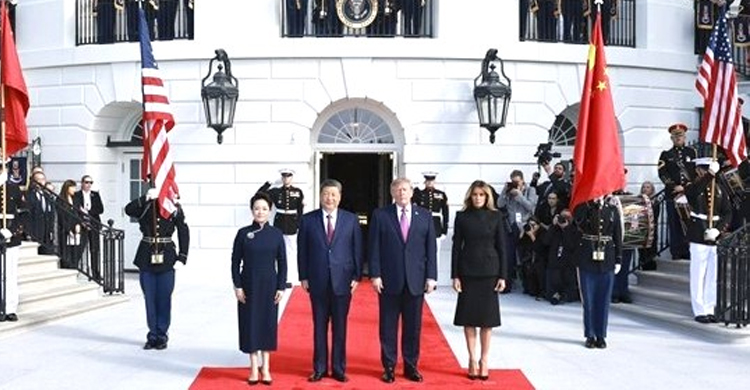
| International, September 26 : Another handshake across the Pacific. Once again, the world’s attention is focused on China and the United States. At the invitation of US President Donald Trump, Chinese President Xi Jinping paid a state visit to the United States from September 23 to 25. Within less than six months, the two heads of state met in person again. At a critical moment for China-US relations, their meeting and exchanges have provided new guidance for bilateral ties.
The pace of change in the world has accelerated, and history has entered a new chapter. Under such circumstances, China and the United States, as two major countries, bear important responsibilities for the development and progress of humanity.
During his visit to Washington, Xi Jinping and President Trump held candid and in-depth exchanges and reached many new common understandings. They further enriched the substance of a constructive and strategically stable China-US relationship and provided new strategic guidance for bilateral ties.
On the first floor of the White House are photographs of the two heads of state meeting in Busan last year and their meeting in Beijing in May this year. Following that sequence, another moment has now been added to history with Xi Jinping’s participation in a welcome ceremony hosted by President Trump at the White House.
As the world’s two largest economies, the strategic decisions of China and the United States affect not only bilateral relations but also the trajectory of the global situation.
During President Trump’s visit to China in May this year, the heads of state of the two countries agreed to build a constructive and strategically stable China-US relationship. President Xi Jinping has explained the significance of this new position from four perspectives: positive stability by prioritizing cooperation; sound stability by limiting competition; normal stability through managing differences; and lasting stability by making peace more predictable.
This new position reflects the realities of China-US relations while also expressing expectations for their future development. It embodies the aspirations of the peoples of the two countries, the expectations of the international community and the fundamental interests of China and the United States.
In his speech at the White House welcome ceremony, Xi Jinping emphasized strengthening communication, sincere cooperation and peaceful coexistence, providing guidance for advancing a constructive and strategically stable China-US relationship.
On the morning of September 25 local time, Xi Jinping and his wife, Peng Liyuan, joined President Trump and his wife, Melania Trump, for a tea gathering at the White House. There, the heads of state of the two countries agreed to further enrich the substance of the China-US relationship and jointly build a “constructive and strategically stable relationship based on respect, fairness and reciprocity.”
China-US relations are linked to the well-being of more than 1.7 billion people in the two countries. At the same time, their impact extends to the interests of more than 8 billion people around the world. Looking toward the future, Xi Jinping’s position is clear: realizing the great rejuvenation of the Chinese nation and “making America great again” can be compatible goals, can help advance each other and can bring benefits to the world.
Recently, the economic and trade teams of China and the United States held a new round of talks and reached consensus on a new joint arrangement. This also sends a positive message to industries in both countries, ordinary people and the global economy.
The interests of China and the United States are deeply intertwined, and there is broad scope for cooperation. Although China-US cooperation cannot solve all the world’s problems, it would be difficult to resolve many global problems without cooperation between the two countries.
During his talks with President Trump, Xi Jinping said, “Cooperation is a two-way street. To maintain the stability of China-US economic and trade relations, we need to expand the list of areas for cooperation while also reducing the list of problems.”
Xi Jinping further said that by maintaining a spirit of equality, respect and mutual benefit, it is possible to find ways to resolve problems. He expressed hope that both sides would move toward each other, uphold mutually beneficial and win-win cooperation and promote the sustainable and stable development of China-US economic and trade relations.
In the first half of this year, the total value of China-US trade in goods reached 2 trillion yuan. According to a report by the US-China Business Council, 92 percent of the US companies surveyed reported profits in China in 2025. Meanwhile, 95 percent of the companies said their business in China helped them maintain competitiveness globally. These positive signals from the market demonstrate the practical benefits of economic and trade cooperation between China and the United States.
A new technological revolution is advancing rapidly. Both the potential and risks of artificial intelligence are becoming increasingly apparent. This has also presented a new question to all of humanity.
During his talks with President Trump, Xi Jinping said, “China and the United States are both major powers in artificial intelligence. There is competition between the two sides, but there can be even more cooperation. In this regard, we should demonstrate our capabilities, not build defensive measures against each other.”
Strengthening communication and dialogue between China and the United States, building consensus, and advancing artificial intelligence toward more sophisticated and beneficial applications are important parts of implementing the consensus reached by the two heads of state. This could also provide important experience for global digital governance.
More than 20 years ago, an American citizen named Ronald Sakolski helped Chinese desertification-control worker Yin Yuchen plant trees. Some time ago, he returned to China and saw that the desert where the trees had once been planted had now been transformed into a green forest.
“This story has touched many Chinese people and is an example of friendly exchanges between the peoples of China and the United States.” At the welcome banquet hosted by President Trump, President Xi Jinping cited this example to note that people-to-people and cultural exchanges help enhance communication and understanding between the peoples of the two countries and strengthen the public foundation for friendly cooperation between China and the United States.
Looking back at the history of people-to-people exchanges between the two countries, from the romance of Kulang and the friendship of the “Flying Tigers” to ping-pong diplomacy and the beginning of a thaw in relations, friendship between China and the United States has always been rooted in the peoples of both countries and passed down from generation to generation.
In a speech delivered in San Francisco, the United States, in November 2023, Xi Jinping announced, “China is willing to invite 50,000 young Americans to visit and study in China over the next five years.”
This initiative achieved its target more than two years ahead of schedule. Young Americans who visited China said, “The taste, touch, smell and scenery of China all come together to create a captivating picture.”
However, they want to share with others not only that picture, but also their own experiences and their changing perspectives on the world.
At the White House welcome ceremony this time, Xi Jinping announced that China would invite another 100,000 young Americans to visit and study in China over the next five years.
The new initiative will create more opportunities for mutual learning and exchanges among young people from the two countries and build new bridges of mutual understanding and friendship. The peoples of China and the United States will move forward hand in hand and jointly nurture the beautiful flower of friendship with greater care.
From Beijing to Washington, this “two-way journey” across the Pacific has undoubtedly added another important chapter to the history of China-US relations. There is broad confidence that, under the strategic leadership of head-of-state diplomacy, the substance of the constructive and strategically stable China-US relationship will continue to deepen, adding stability and positive energy to a changing and uncertain world.
Source: Swarna, Foysal, Anandi, China Media Group.
|