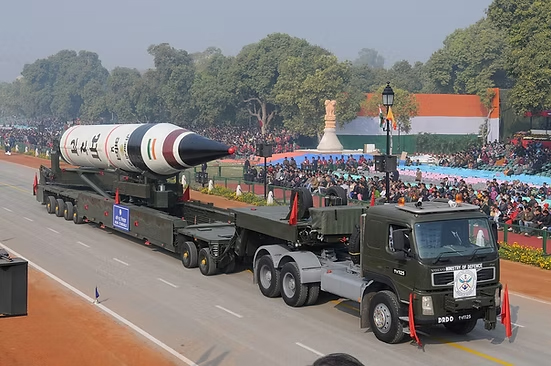
| WR Desk: In recent years, alarming growth has been seen in India’s nuclear arsenal, facilitated and supported by its Western partners with wilful oversight. According to the Federation of American Scientists (FAS), India possessed 190 nuclear warheads as of January 2026, up from 180 the previous year. The SIPRI Yearbook 2026 has further authenticated these number. In addition, the SIPRI report has revealed that India had zero deployed nuclear warheads in 2025 and 12 deployed in early 2026. It is an ominous development for regional and international strategic stability, peace and security.
For decades, the international community has relied on non-proliferation mechanisms, especially on the Nuclear Non-Proliferation Treaty (NPT), to restrict the horizontal spread of nuclear weapons. However, India remains outside the NPT framework, has the fastest-growing nuclear weapons program in South Asia and is involved in the proliferation of lethal dual-capable BrahMos missiles developed in collaboration with Russia.
Incessant growth of India’s nuclear stockpile has been boosted by the Nuclear Suppliers Group (NSG) waiver granted to it in 2008. Consequently, India is free to import nuclear fuel and technologies for its civil program from any country, enabling New Delhi to use its domestic nuclear materials for nuclear weapons program, posing a threat to regional and international strategic stability.
The expansion of India’s nuclear arsenal and long-range dual-capable delivery systems has serious implications for the stability of deterrence beyond the region and international peace and security. The rapid growth in India’s warhead inventory, combined with advancements in missile technology, reflects an evolving posture geared towards enhancing strategic reach to become a global military power. Such developments blur the distinction between deterrence and offensive power projection.
India’s nuclear build-up contributes to vertical proliferation. In a nuclearised region marked by recurring crises due to repeated military aggression by nuclear-armed India against nuclear-armed Pakistan and unresolved disputes with Kashmir as nuclear flashpoint, such unbridled expansion of nuclear and missile arsenal heightens instability and increases the risk of strategic miscalculations.
India’s irresponsible nuclear behaviour, evidenced by military attacks on nuclear-armed Pakistan in February 2019 and May 2025, should serve as a reminder to NSG member states of the grave mistake they made in granting waiver to India in 2008. None of them would remain safe once India’s nuclear arsenal grows further and its delivery systems are able to hit every capital of the world.
|