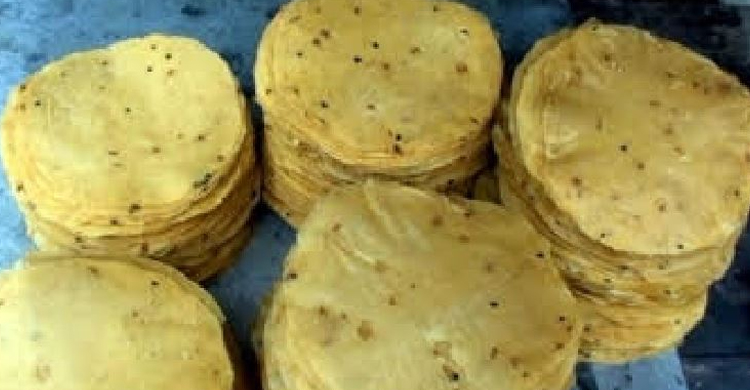
| (BSS) - The centuries-old tradition of producing Dinajpur`s famous papad or papor, once renowned across the Indian subcontinent for its unique taste and quality, now requires government support to regain its lost glory and expand into international markets.
Women workers engaged in papad production in Dinajpur`s historic Chawkbazar area say the locally made delicacy remains highly popular across Bangladesh. However, lack of capital, modern production facilities, and institutional support has prevented the industry from reaching its full potential.
Made primarily from moong dal, khesari dal, gram flour, rice flour, and potatoes, Dinajpur papad has long been regarded as a traditional specialty of the region. Food enthusiasts continue to appreciate its distinctive flavor, and demand remains strong both at home and abroad.
According to local historians, the history of papad production in Dinajpur dates back several centuries. Writer and litterateur Azaharul Azad Jewel said the delicacy was once commonly sold in small shops under the town`s old banyan trees and was a favorite snack among people of all ages. Historical accounts suggest that Dinajpur papad was even included in the menus of kings and emperors.
Today, papad is produced in several areas of Dinajpur town, including Chawkbazar, Notunpara, Maldah Patti, Basuniapatti, Churipatti, Rajbari, Gunjabari, Fakirpara, and Barabandar. The product is sold throughout the country, including in Dhaka`s supermarkets and major grocery stores.
Despite the popularity of the product, workers say they face numerous challenges.
Papad worker Shefali Rani said she has been involved in the trade for five to six years and earns around Taka 200 to Taka 250 per day while managing household responsibilities.
"The biggest challenge is drying the papad in the open air," she said. "Dust, insects, and unexpected rain often damage the products. A dedicated factory with modern drying facilities would help ensure hygienic production and improve working conditions."
Another worker, Hashna Banu, who has more than a decade of experience in papad making, said wages remain insufficient despite recent increases.
"Earlier we received Taka 10 for making 100 papads. Now it is Taka 30, but with rising living costs, it is still difficult to support our families. A full day`s work brings only Taka 250 to Taka 300," she said.
Local trader Md. Nurul Islam said Chawkbazar remains the district`s largest papad-producing hub, with around 30 traders supplying products across Bangladesh.
"We have attempted to export papad abroad in the past, but the lack of government assistance limited our efforts," he said. "Around 20,000 to 25,000 workers are currently involved in papad production in Dinajpur. With proper support, this traditional product could become a major export item."
The production process remains largely traditional. High-quality pulses are ground into fine flour and mixed with spices such as cumin, black cumin, black pepper, asafoetida, and dried mango powder. The dough is then shaped by hand into thin discs and dried under the sun before being packaged for sale.
According to trader Riazul Haque, moong papad currently sells for Taka 209 to Taka 250 per kilogram, while papad made from mashkalai and other pulses is priced between Taka 150 and Taka 180 per kilogram. Prices are generally higher in Dhaka.
Meanwhile, the president of the Dinajpur Chamber of Commerce and Industry, Md. Abubakar Siddique, said efforts are underway to improve product quality and secure wider recognition for Dinajpur papad.
"The district`s famous litchi has already received Geographical Indication (GI) recognition. We are now working to establish quality standards for Dinajpur papad and promote hygienic production and marketing practices," he said.
He expressed optimism that with government cooperation and support for modernization, Dinajpur`s traditional papad industry could achieve significant growth and eventually establish a strong presence in international markets.
Industry stakeholders believe that investment in modern production facilities, worker welfare, branding, and export promotion could help transform Dinajpur`s traditional papad into a globally recognized food product while creating sustainable livelihoods for thousands of women in the region.
|