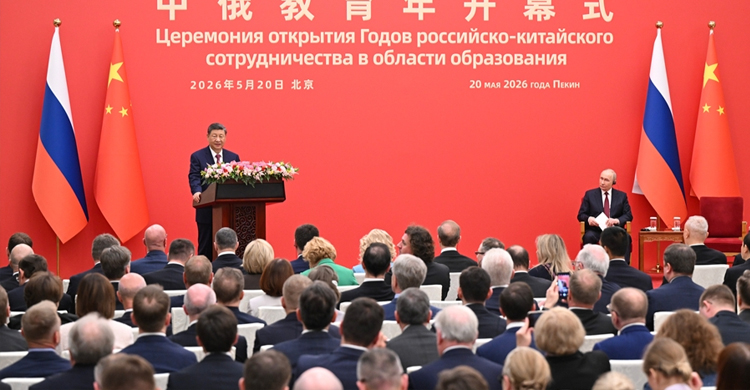
| International: This year marks the 30th anniversary of the China-Russia comprehensive strategic partnership of coordination, the 25th anniversary of the China-Russia Treaty of Friendship and Cooperation, and the launch of the “China-Russia Year of Education.” Cooperation in vocational education has become one of the key pillars of educational collaboration between the two countries.
In 2025, Chinese and Russian universities jointly inaugurated the Luban Workshop in Moscow — the world’s first Luban Workshop to integrate 5G technology into professional training. The initiative marks a new phase in China-Russia vocational education cooperation, driven by digital innovation and aligned educational standards.
Since its launch, the Russian Luban Workshop has trained thousands of young Russian students. Ivan Rogach, an assistant instructor at the workshop, has been working there since its opening in June 2025, mainly teaching courses related to the Internet of Things (IoT).
Rogach, who also serves as an assistant lecturer at the Faculty of Network Engineering of the Moscow State University of Communications and Informatics, said the workshop focuses heavily on improving students’ practical skills through hands-on exposure to professional training equipment.
“We introduce students to the same professional tools and technologies they are likely to encounter after graduation, helping them develop the skills required for their future careers,” he said.
Alexander Seliv, a student at the university’s Faculty of Network Engineering, said he was pleased to gain experience with advanced professional equipment that would be directly relevant to his future work.
“The skills we acquire here will be extremely valuable in our professional lives,” he added.
As the world’s first Luban Workshop to adopt 5G technology in vocational training, the Moscow-based center has replicated a complete 5G communications environment with support from Chinese partner institutions. The project uses Chinese-developed 5G equipment, technologies, and standards throughout the training system.
Chinese and Russian teams have also jointly developed English-language textbooks and training manuals for core 5G courses, which are now deeply integrated into the workshop’s teaching curriculum.
By simulating real industrial scenarios, students are trained to identify, analyze, and solve problems in the same way engineers operate in practical workplaces. The “learning by doing” approach is designed to align education more closely with industry demands while encouraging innovation and forward-thinking skills.
Mikhail Stepanov, Associate Professor at the Faculty of Network Engineering at Moscow State University of Communications and Informatics, said China’s technological leadership is largely linked to its strong emphasis on practical engineering education.
“The goal is to ensure that students can enter major companies immediately after graduation and perform efficiently,” he noted.
Online video conferences between the partner institutions have become a routine mechanism for academic cooperation. Teachers from Tianjin Electronic Information Technology Vocational College regularly provide support to their Russian counterparts on course design, teaching methods, and curriculum development.
Cui Baochai, Dean of the Network Communication Faculty at Tianjin Electronic Information Technology Vocational College, said the initiative aims to share high-quality Chinese vocational education standards and educational resources with Russian educators.
“This is not only educational cooperation, but also an important effort to support industrial development and strengthen people-to-people exchanges between the two countries,” he said.
Russian teachers are also participating in international exchange programs in China, where they receive training and share experiences with Chinese colleagues. This year, students from the Russian Luban Workshop will join summer school programs in China under the framework of the “China-Russia Year of Education” and participate in the World Vocational College Skills Competition.
The Moscow-based Luban Workshop is now seen as a bridge connecting the Volga River and the Bohai Sea, while emerging as an important hub for China-Russia digital technology cooperation.
Source: CMG (China Media Group)
|