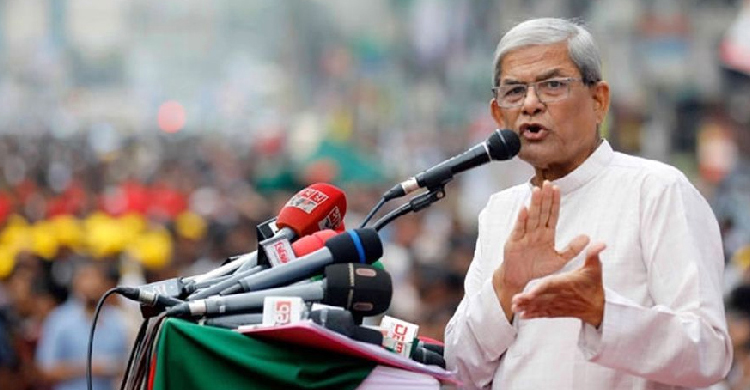
| BNP Secretary General and Local Government Minister Mirza Fakhrul Islam Alamgir has stated that the future of diplomatic relations between Bangladesh and India depends heavily on the successful negotiation and execution of the Ganges water sharing treaty, also known as Farakka treaty.
Speaking at a discussion on Saturday to mark the historic Farakka Long March Day, the senior leader sent a clear message to New Delhi, urging for a resolution that aligns with the needs and expectations of the Bangladeshi people.
The BNP leader emphasized that the Farakka Barrage significantly impacts the livelihoods and biodiversity of nearly one-third of Bangladesh’s population.
He warned that the lack of a fair water-sharing agreement continues to threaten the country’s environmental stability. He recalled that veteran political leader Maulana Bhashani had foreseen the environmental devastation the Farakka Barrage would cause. Fakhrul noted that BNP founder and former President Ziaur Rahman also understood this reality, taking the issue to the international stage and securing a treaty that largely favored the people of Bangladesh.
Criticizing past diplomatic failures, Mirza Fakhrul claimed that the country’s water security challenges began during the tenure of Sheikh Mujibur Rahman, when the barrage was first permitted to operate.
While noting that subsequent leaders including Shaheed Ziaur Rahman, Khaleda Zia, and Sheikh Hasina signed various agreements, he argued that short-term fixes are no longer sufficient. He called for an indefinite treaty that ensures a guaranteed water share until any new agreement is reached.
With the current water-sharing treaty set to expire in December 2026, the BNP leader expressed concerns over the lack of a guaranteed renewal.
He praised the strategic foresight of the party’s current leadership, noting that plans to construct the Padma Barrage are being prioritized to safeguard national interests despite external pressures.
He concluded by asserting that such bold, patriotic decisions are essential for the country’s survival and sovereignty.
|