| International Desk: AI agents such as “OpenClaw” are energising the artificial intelligence application market in China, while “solo companies” are emerging nationwide, humanoid robots are advancing rapidly, and the “token economy” is attracting active investment across the industrial chain. Artificial intelligence is now revitalising traditional industries and fostering innovation in emerging and future-oriented sectors.
For the first time, this year’s Chinese Government Work Report highlighted the goal of “developing new forms of the intelligent economy.” AI, described as a “key transformative variable,” is increasingly becoming a powerful catalyst for China’s high-quality economic development.
At the recently held 2026 Beijing E-Town Humanoid Robot Half Marathon, more than 100 humanoid robot teams participated. The number of robots equipped with autonomous navigation capabilities increased significantly, and the best-performing robots even surpassed human benchmarks in some aspects. Several companies demonstrated robots capable of independently conducting path planning, obstacle avoidance, and gait control. Behind these achievements lies the advancement of embodied AI “brains” and “cerebellums,” along with coordinated efforts across the entire industrial chain.
From language interaction to task execution, and from technological breakthroughs to ecosystem expansion, AI agents are accelerating the large-scale adoption of foundation models while substantially increasing token usage.
By March this year, China’s average daily token consumption had exceeded 140 trillion—more than 1,000 times higher than the 100 billion recorded in early 2024. A new economic model, known as the “token economy,” is rapidly taking shape, built around token metrics, usage, accounting systems, and value conversion mechanisms.
The scale and efficiency of computing power are now directly determining the pace of development of the intelligent economy. This year’s Government Work Report called for the implementation of “mega-scale AI computing clusters, computing-power co-optimisation and other new infrastructure projects,” while also strengthening “national integrated computing power monitoring and scheduling.”
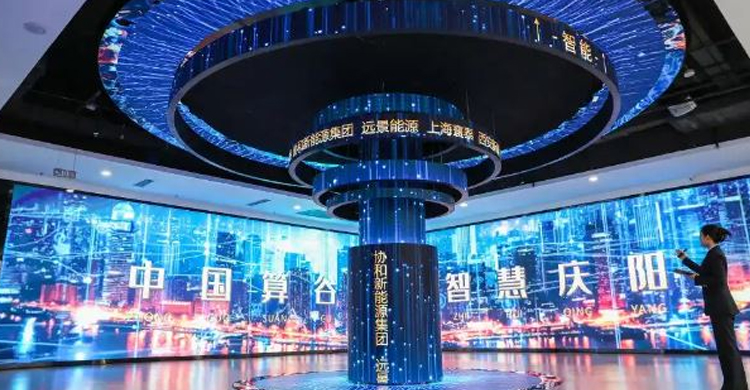
At the China Mobile Data Centre Park in Qingyang, Gansu Province, uninterrupted clean electricity is being delivered directly to server facilities through an integrated green power supply project. In the desert region, “watts” are being transformed into “bits,” shaping a development model where “green electricity attracts computing power, and computing power drives economic growth.”
At the same time, China’s largest scientific computing cluster has been launched at the National Supercomputing Internet Core Node in Zhengzhou, Henan Province. Construction has also begun on a Space Computing Power Innovation Centre, focusing on space-based AI chips and other technologies aimed at “taking computing power into space.” Meanwhile, the Ministry of Industry and Information Technology is advancing policy research and standard-setting efforts for computing-power co-optimisation, accelerating integration across power sources, networks, storage, workloads, and direct green electricity connectivity.
By the end of March, China’s intelligent computing capacity had reached 1,882 EFLOPS, while more than 70 computing-power expressways had been built around major computing hubs, making the nation’s “computing highways” more efficient and interconnected.
During the first quarter of the year, the added value of industries directly linked to AI production and application—including electronic specialised materials manufacturing, in…
|