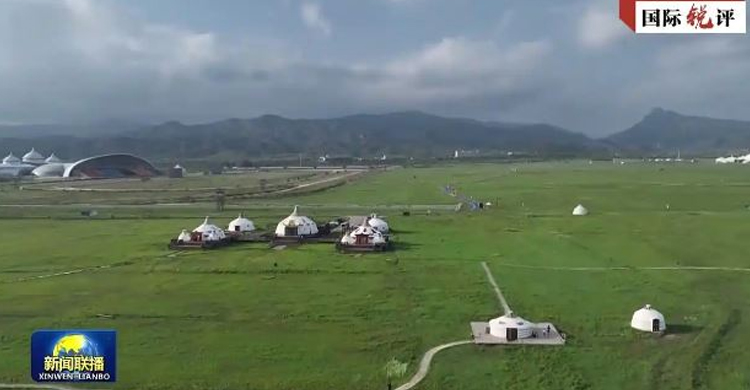
| International: A new chapter has been added to China’s opening-up map with the release of the “Overall Plan for the China (Inner Mongolia) Pilot Free Trade Zone,” bringing the total number of China’s pilot free trade zones to 23. According to international observers, the addition of this “new member” in the first year of the 15th Five-Year Plan has further strengthened the country’s open development framework by enhancing land–sea connectivity and coordinated east–west development.
The move is expected not only to drive high-quality development but also to provide greater stability in an uncertain and rapidly changing global environment, reflecting China’s firm commitment to high-level opening-up.
Why was the new pilot free trade zone established in Inner Mongolia? First, its unique geographical location plays a key role. Historically, Inner Mongolia served as an important hub along the “Grassland Silk Road” and the ancient Tea Road. Today, it is a key node in the Belt and Road Initiative and the China–Mongolia–Russia Economic Corridor.
The region shares a border of over 4,200 kilometers and hosts 20 open ports, linking eight domestic provinces while connecting Europe and Asia externally—making it naturally positioned as a gateway for northward opening-up.
In addition, Inner Mongolia already has a solid foundation in foreign trade openness. In 2025, the region’s total import and export volume reached 220.67 billion yuan (approximately 2,206.7 billion yuan in total value terms), a historic high and 2.6 percentage points above the national average. It currently maintains trade relations with 201 countries and regions, with trade with Belt and Road partner countries accounting for 78.6 percent of its total foreign trade.
As a border region, what role will Inner Mongolia play in China’s broader free trade zone framework? According to Sang Baichuan, Director of the Institute of China Open Economy Studies at the University of International Business and Economics, the key objective of the plan is to develop the Inner Mongolia FTZ into a major gateway for northward opening-up. Leveraging its resource advantages and proximity to Russia and Mongolia, the region is expected to develop specialized industries and become a strategic highland for border-region development and opening-up.
The plan further envisions the zone as a hub connecting domestic and international markets, and as a center for information exchange, transportation and logistics, resource allocation, technological innovation in key sectors, and industrial cooperation. These “five centers” will integrate flows of information, goods, capital, technology, and industry, thereby supporting high-quality regional economic development.
The establishment of the Inner Mongolia Pilot Free Trade Zone represents a latest practice in China’s reform and opening-up process. What will this new FTZ bring to the world?
In practical terms, as a high-standard platform for trade and investment liberalization and facilitation, pilot free trade zones create substantial opportunities for global trade and investment, enabling international partners to better share China’s development dividends. At the same time, amid rising geopolitical tensions and increasing global logistics risks, Inner Mongolia—home to both eastern and central corridors of the China–Europe freight railway—plays an increasingly important role as a “golden corridor.”
More importantly, while some countries are turning toward unilateralism and protectionism, China continues to improve its free trade zone framework and deepen institutional opening-up, setting a strong example for global partners. This also…
|